

Most homes in Greater Western Sydney have more outdoor space than they actually use. A patch of grass, maybe a concrete slab, and a Hills Hoist. But the way families use their properties has shifted, and a well-built outdoor area improves how you live in your home and what it's worth when you sell.
Buyers in Greater Western Sydney pay attention to outdoor areas. A finished entertaining space, a covered deck, or an outdoor kitchen can be the thing that pushes a buyer from interested to making an offer. In suburbs like Kenthurst, Kurrajong, and Maraylya where properties sit on larger blocks, an underdeveloped backyard is a missed opportunity.
It's also about how you use your home day to day. A covered outdoor area means you're not stuck inside when it rains, and you've got somewhere to host that doesn't involve rearranging the lounge room. For families, it's extra room for kids to move around. For people who like to entertain, it's a proper setup with bench space, a BBQ, and somewhere to sit.
Not every outdoor upgrade carries the same weight. Some add lifestyle value, others add financial value, and the best ones do both. Here's what we build most often across the Hawkesbury and Hills District.
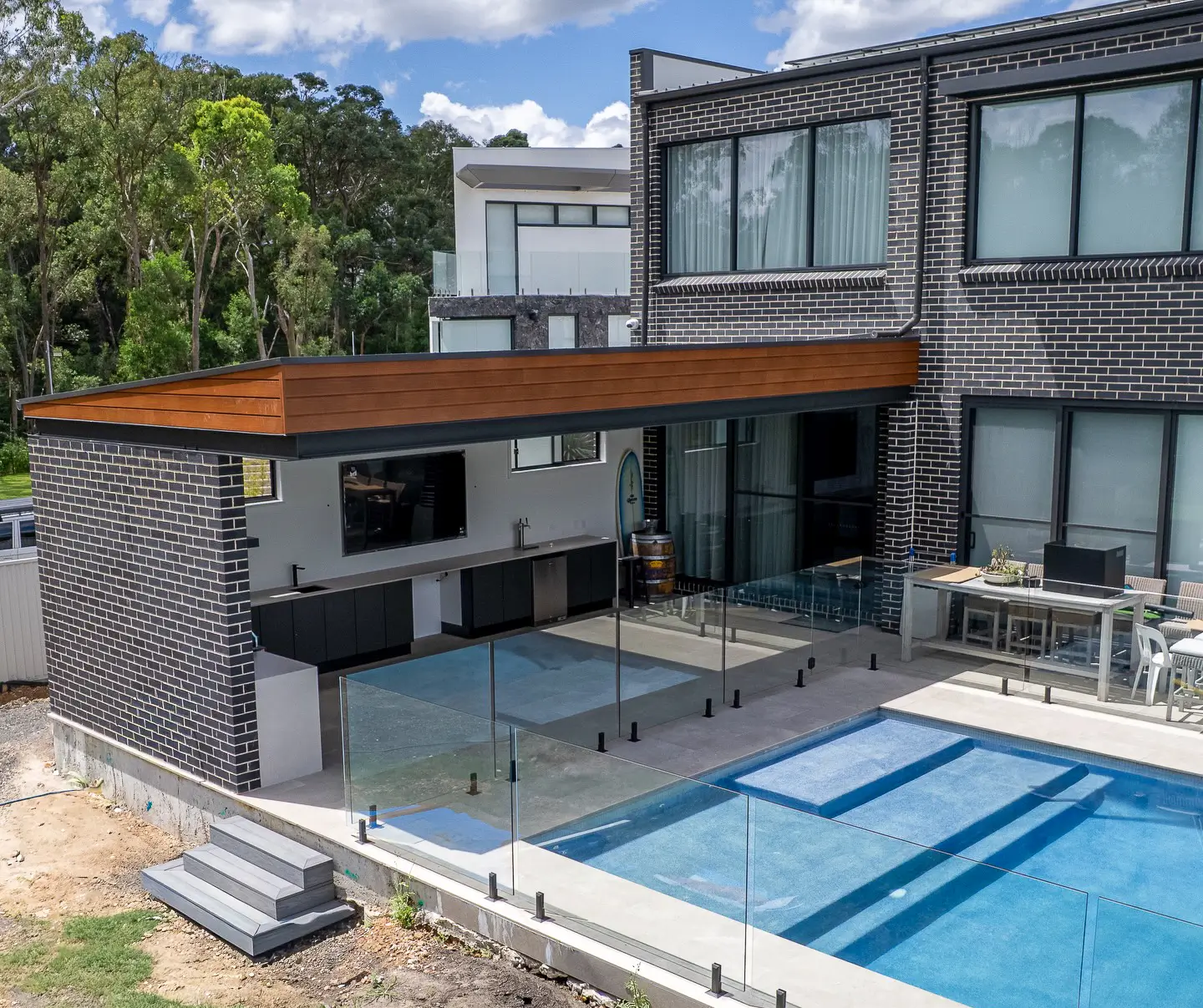
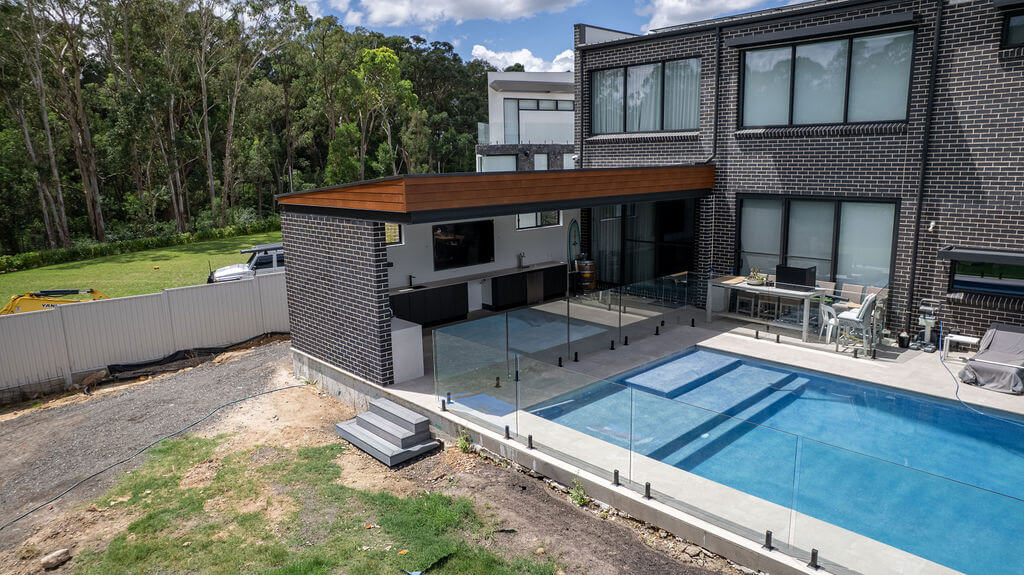
This is the most common request we get. A dedicated outdoor space with a built-in BBQ, stone benchtops, sink, and covered seating area. Done properly, it becomes the most-used part of the house in warmer months.
We recently completed a custom pool house in the Hills District with a full outdoor kitchen, dark cabinetry, rangehood, and timber batten ceiling. That kind of build turns a backyard into a space people actually want to spend time in every weekend.
The scope can range from a simple BBQ area with a benchtop and storage through to a full outdoor kitchen with cabinetry, rangehood, sink, and integrated seating under a covered pergola. Where you land on that scale depends on how you use the space, how often you entertain, and what suits the property.
The key is connecting it back to the house. If the outdoor area feels separate or disconnected, it doesn't get used as much. We design every outdoor build to flow from the interior, so the transition from kitchen or living room to the outside feels natural. That might mean matching floor levels, aligning the outdoor kitchen with the internal kitchen layout, or making sure the sightlines from inside draw you out.
A quality hardwood or composite deck changes the usability of a backyard. It gives you a flat, clean surface to put furniture on, walk on barefoot, and use in all weather.
On sloped blocks, which are common across the Hawkesbury and Hills District, a deck can turn an unusable section of yard into a proper outdoor area. A 30sqm deck on a flat block is a straightforward build. The same deck on a sloped block with 1.5 metres of fall underneath requires a much larger substructure, and the scope changes significantly. We build on sloped sites regularly and design the substructure to suit the terrain rather than trying to force a flat-block approach onto a falling block.
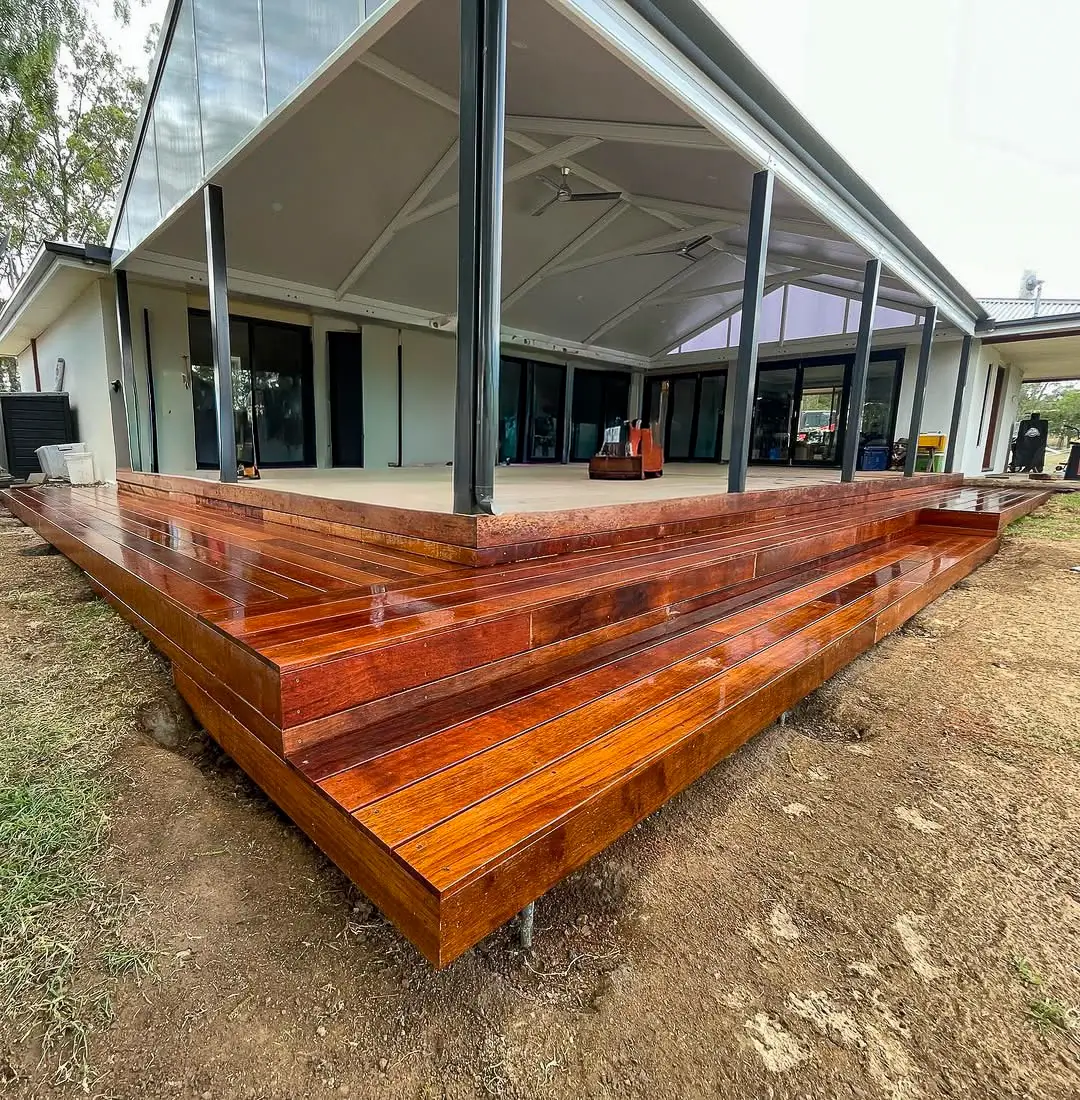
Our Kurrajong project was an 80sqm Merbau deck with a gabled pergola above it and custom wraparound stairs at the corner. On a rural property like that, the deck completely changed how the outdoor space was used.
Decking works best when it's part of a bigger plan. A standalone deck is fine, but a deck under a pergola with lighting, a ceiling fan, and a clear connection back to the house is a different result altogether. If you're thinking about adding a pergola down the track, it's worth planning for it now. Building both at the same time saves on mobilisation, trades coordination, and often materials compared to doing them as separate projects.
This question comes up in almost every decking conversation. Here's the honest comparison.
Merbau looks great when freshly oiled. It's warm underfoot, has a rich colour, and is the most affordable hardwood option. But it needs oiling every 12 months to hold its colour. And in the first 6 to 12 months after installation, Merbau bleeds tannins. That's a reddish-brown stain that runs onto concrete, pavers, and anything nearby when it rains. If your deck sits above a concrete path or near a pool, this is something to be aware of before you commit.
Spotted gum is the premium timber option. It bleeds less tannin than Merbau, it's harder, and it has a lighter, more varied grain. It costs more per square metre but is a strong choice if you want natural timber with less maintenance drama.
Composite decking costs more upfront but needs nothing beyond a wash with soapy water. No oiling, no sanding, no staining. Over 15 to 20 years, composite typically works out cheaper when you account for ongoing maintenance. The trade-off is that composite can get hot underfoot in direct summer sun and the look is different to natural timber. Some people prefer it, others don't.
We build in all three. We'll walk you through the options on site and recommend what suits your block, your budget, and how much maintenance you want to do.
A pergola gives you shade, shelter, and a reason to be outside when it's 35 degrees or raining.
The roof type makes a big difference to how the space performs. Polycarbonate roofing lets light through but also lets heat through, and it gets noisy in heavy rain. Standard Colorbond keeps the rain out but doesn't insulate. Insulated roof panels (like Stratco Cooldek or similar) are the option we build most often because they keep the heat out in summer, stay quiet in the rain, and provide a clean flat ceiling that can take fans and downlights.
We build steel-framed and timber pergolas depending on the look and the span required. For larger areas (anything over about 4 metres wide), steel posts are usually required for structural support. We often combine steel posts with a timber-lined ceiling because it gives you the strength you need with the look and feel of natural timber overhead. A ceiling fan and a few downlights and you've got an outdoor room you can use at 9pm on a Friday night or at midday in January.
This is one of the simplest upgrades that makes the biggest difference. Replacing a small sliding door with full bi-fold or stacking doors opens the living area right out to the deck or patio. The house immediately feels bigger, brighter, and more connected to the outside.
On renovation projects, we'll often recommend this as part of a broader scope. If you're already renovating the kitchen or living area, adding large-format doors to the rear wall and extending out to a new deck or alfresco area is a logical addition that increases the value of the whole project.
In NSW, many outdoor structures like decks and pergolas can be built without council approval as long as they meet the exempt development criteria. That generally means a floor area of 25sqm or less, a height of 3 metres or less, and set back at least 900mm from the boundary (or 5 metres in rural zones). There are additional conditions around heritage areas and bushfire-prone land.
If your project exceeds those limits, you'll need either a Complying Development Certificate (CDC) or a full Development Application (DA). We handle the approval process on every project and make sure everything is compliant before we start building.
Hardwood looks great but needs regular oiling to hold its colour. Composite is low-maintenance but costs more upfront and feels different underfoot. Spotted gum sits in between with less tannin bleeding and a harder surface. We'll walk you through the options based on your property, how much upkeep you want to do, and what finish you're after.
The best outdoor areas are designed as an extension of the home, not a separate structure at the back of the yard. Think about how you move between the kitchen, living area, and outdoor space, and design around that flow. If the transition from inside to outside feels natural, the space gets used every day. If it feels disconnected, it becomes a weekend-only area at best.
Where the sun hits, how water runs off the block, and what's around you all affect how the space performs. On Hawkesbury blocks this matters more than most areas because the terrain varies so much. A north-facing deck in full afternoon sun needs a different approach to a south-facing patio that sits in shade most of the day. Sloped blocks also need proper drainage planning so water doesn't pool under or around the structure. We design around your actual property, not a generic layout.
If you're planning a deck, a pergola, and an outdoor kitchen, doing them together as one project is more efficient than building them separately over time. You save on site setup, trades coordination, engineering, and often materials. It also means the whole space is designed as one cohesive build rather than a series of additions that were figured out along the way.
A well-built outdoor area gives back every day. It creates more space to relax, entertain, and enjoy your home, while also adding appeal when it comes time to sell.
The best results come from getting the layout, materials, and connection to the house right from the start. On a Hawkesbury or Hills District property, that also means accounting for the slope, orientation, and how the block drains. Done properly, it becomes a part of how you live, not something you have to maintain or work around.
If you've got a project in mind, we're happy to come out, look at the site, and give you a straight answer on what's involved.
.webp)
Deciding if you should renovate, extend or knock down and rebuild in 2026? Here's how to weigh it up for a Western Sydney, Hawkesbury or Blue Mountains home.
.svg)

Two builders quoted the same job thousands apart? Here's how to read a quote properly, what PC sums and exclusions really mean, and a ten-point checklist for comparing them.
.jpg)
Adding space to your home in the Hawkesbury or Hills District? Here's how building out compares to building up, what your block allows, and what to plan for.
%C2%A0%E2%80%94%20%D0%BA%D0%BE%D0%BF%D0%B8%D1%8F.svg)