

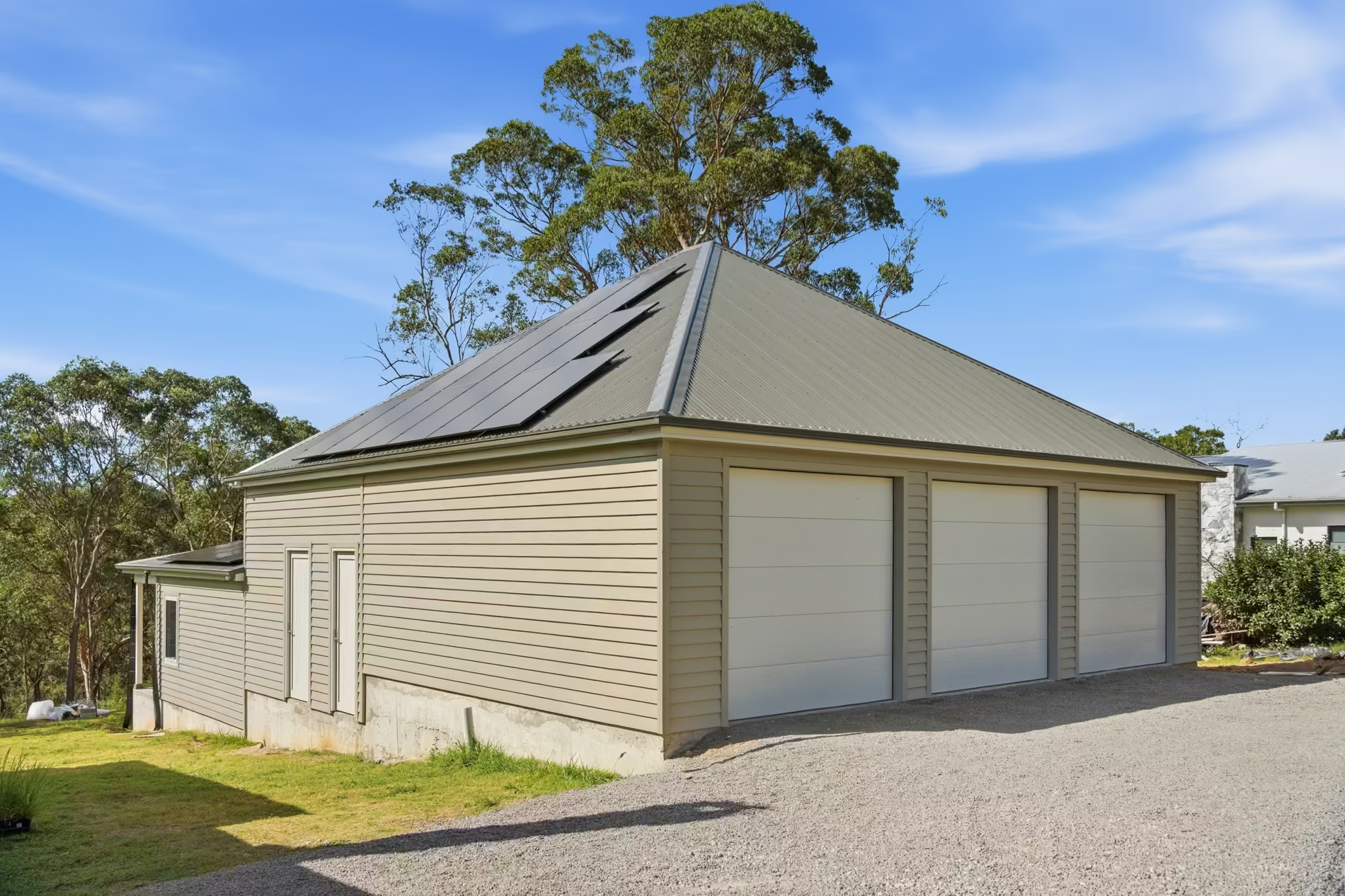
Granny flats are one of the fastest-growing project types across Greater Western Sydney, and for good reason. A well-built secondary dwelling gives you options. Extra space for parents or adult kids. Rental income on land you already own. A home office or studio that's properly separate from the main house.
On the larger blocks common across the Hawkesbury and Hills District, a granny flat makes use of space that's often sitting idle. A 2,000sqm property in Kurrajong or Kenthurst has room for a secondary dwelling without it ever feeling crowded. That's a different situation to squeezing one onto a 450sqm suburban lot.
But the rules, the approval pathway, and the site work involved vary a lot depending on your block. This guide covers how it works in NSW, where Hawkesbury and Hills properties differ from the standard process, and what to think about before you start.

In NSW planning law, a granny flat is called a secondary dwelling. It's a self-contained home on the same lot as your existing house, with its own kitchen, bathroom, and living area. It can be freestanding in the backyard, attached to the main house, or built above a garage.
The key rules under the NSW Housing SEPP:
60sqm is more space than most people expect. It comfortably fits a one-bedroom layout with open-plan living, or a compact two-bedroom design. The constraint pushes you toward smart layouts rather than wasted hallway space, which is why well-designed granny flats often feel bigger than they are.

There are two ways to get a granny flat approved in NSW, and which one applies to your block makes a big difference to the timeline.
If your property and design meet the standard requirements, a granny flat can be approved through a CDC issued by a private certifier. This typically takes 10 to 20 business days. No council assessment, no neighbour notification period, no waiting months for a decision.
To qualify, the project generally needs to meet conditions like:
If everything lines up, this is the fastest way to get a granny flat out of the ground in NSW.
If your property falls outside the complying development criteria, the project goes through a DA with your local council. This takes longer, often 40 to 60+ business days, and involves a full assessment against the council's planning controls.
A DA isn't a roadblock. It's just a slower pathway with more documentation. Plenty of granny flats across the Hawkesbury go through a DA and get approved without drama. The key is knowing which pathway applies to your block before you start designing, so the timeline doesn't catch you out.
This is where building in this area differs from the rest of Sydney, and it's the part most generic granny flat guides skip.
A large share of semi-rural properties around Kurrajong, Bilpin, Colo, and the edges of the Blue Mountains sit on bushfire-prone land. If your block falls into the higher bushfire categories, the fast-track CDC pathway isn't available and the project needs a DA. The BAL rating also affects construction. Higher ratings mean specific materials, ember protection, and fire-rated windows, all of which need to be designed in from the start.
Parts of the Hawkesbury are classified as flood-prone, and complying development is restricted on certain flood-affected lots. If your property sits in a flood zone, the approval pathway, floor levels, and construction methods all change. It doesn't usually rule out the project. It changes how it needs to be planned.
Many Hawkesbury properties sit on rural or large-lot zoned land rather than standard residential zones. Granny flats are generally still possible on these blocks, but the approval usually runs through a DA rather than a CDC, and the specific rules depend on how your lot is zoned. This is something we check at the start of every project, because it shapes the whole timeline.
The short version: on a flat residential block in Rouse Hill, a granny flat is often a CDC job with a fast approval. On a 5-acre block in Glossodia with a bushfire overlay, it's a different process. Both are buildable. They just need different planning.
.avif)
Approval is one half of the picture. The other half is the physical site, and on bigger blocks this matters more than people expect.
Water, sewer, and power all need to reach the granny flat. On a standard suburban lot, the connection points are close. On a Hawkesbury acreage, the granny flat might sit 40 metres or more from the nearest connection. Trenching and running services across that distance is a genuine part of the scope, and on properties without sewer access, an upgraded septic or wastewater system may be needed to handle the second dwelling.
Sloped blocks are common across Kurrajong, Glossodia, and parts of Kenthurst. A granny flat on a falling block may need cut-and-fill earthworks, retaining walls, or an elevated subfloor design before the build itself starts. Site preparation on a sloped block can be a significant portion of the project, which is why we always walk the site before giving you a number.
Materials, concrete, and trades all need to reach the build location. If the granny flat is going at the back of a long block with no vehicle access, everything changes. Concrete gets pumped instead of poured straight from the truck, and materials get moved by bobcat or by hand. None of this stops a project. It just needs to be factored in upfront rather than found out halfway through.
Most granny flats in this area are freestanding builds in the backyard, and on larger blocks that's usually the right call. You get proper separation between the two homes, which matters if the flat is for rental income or adult kids who want their own space.
An attached granny flat, built onto the side or rear of the main house, can make sense on smaller blocks or where services are easier to share. The trade-off is less privacy and separation between the dwellings.
Converting or building above a garage is the third option. It works on some properties, but the existing structure needs to be assessed for the additional load, and the design has to meet the same self-contained requirements as any other secondary dwelling.
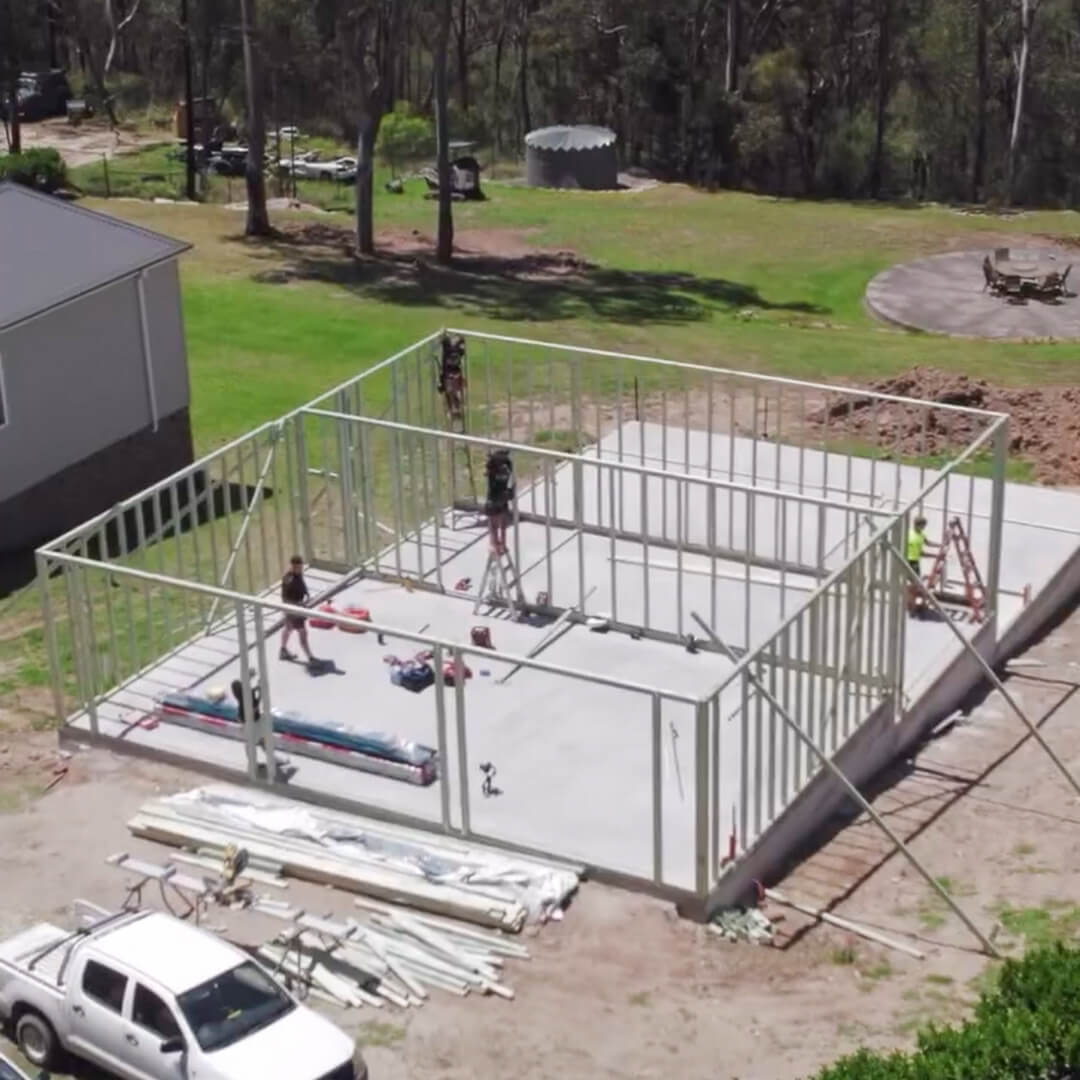
The main variables on any granny flat project:
Size and layout. A one-bedroom design is a simpler build than a two-bedroom layout with a full laundry and separate living zones. Both fit within 60sqm, but the complexity differs.
Site conditions. As covered above, a flat block close to services is a fundamentally different project to a sloped block 40 metres from the nearest connection point. This is the single biggest variable in this area.
Fit-out level. Standard finishes through to stone benchtops, premium tapware, and custom joinery. A granny flat built for rental income usually lands at a different finish level to one built for family to live in long term.
Approval pathway. A CDC project moves faster and carries less documentation than a DA, which affects the overall timeline from first conversation to handover.
If you're weighing up a granny flat against extending the main house, our guide on what to know before you build, renovate, or extend in the Hawkesbury and Hills District covers how the two compare.
Yes. Secondary dwellings can be rented out separately from the main house, which is why they're popular as an income addition on larger blocks. You can't sell it separately, but you can lease it.
A CDC is typically issued within 10 to 20 business days if the project meets the requirements. A DA through council generally takes 40 to 60+ business days, sometimes longer depending on the property and the council's workload.
No. There's no requirement for the secondary dwelling to match the existing home's style or materials, though many owners choose to keep them consistent. On rural blocks, a different look often works well as a deliberate design choice.
Usually yes, but the approval pathway and construction requirements change. Higher bushfire categories rule out the fast-track CDC process and add material and design requirements based on the BAL rating. We check this early so the design accounts for it from day one.
A secondary dwelling is fully self-contained with a kitchen, bathroom, and living area, and can be lived in as a separate home. A studio or habitable outbuilding without a kitchen falls under different rules. If the goal is rental income or independent living, you want a proper secondary dwelling.
Every property is different, and in the Hawkesbury and Hills District the zoning, overlays, slope, and access on your specific block decide what the project looks like. That's why we start with a site visit, not a quote over the phone.
We'll walk the block with you, check the approval pathway that applies to your property, and give you a straight answer on what's involved. No obligation, no pressure.
Get in touch: Call Ben on 0422 406 608 or email admin@b-builtprojects.com.au
.webp)
Deciding if you should renovate, extend or knock down and rebuild in 2026? Here's how to weigh it up for a Western Sydney, Hawkesbury or Blue Mountains home.
.svg)

Two builders quoted the same job thousands apart? Here's how to read a quote properly, what PC sums and exclusions really mean, and a ten-point checklist for comparing them.
.jpg)
Adding space to your home in the Hawkesbury or Hills District? Here's how building out compares to building up, what your block allows, and what to plan for.
%C2%A0%E2%80%94%20%D0%BA%D0%BE%D0%BF%D0%B8%D1%8F.svg)